
North Korea nuclear test: Mattis warns of ‘massive military response’
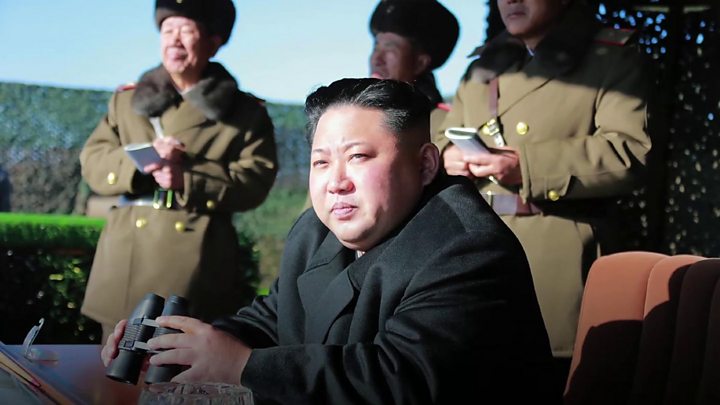
Pentagon chief James Mattis says any threat to the US or its allies by North Korea will be met with a “massive military response”.
His comments came after he attended a national security meeting with President Donald Trump.
Pyongyang says it has successfully tested a more advanced nuclear weapon – a hydrogen bomb that could be loaded on to a long-range missile.
The move has drawn international condemnation.
North Korea has defied UN sanctions and international pressure to develop nuclear weapons and test missiles that could potentially reach the US.
But speaking to reporters outside the White House, Mr Mattis said the US had the ability to defend itself and its allies South Korea and Japan, adding that its commitments were “ironclad”.
“Any threat to the United States or its territories – including Guam – or our allies will be met with a massive military response, a response both effective and overwhelming.”
The UN Security Council is to hold an emergency meeting on Monday to discuss an international response, according to the US mission.
What has happened?
The first suggestion that this was to be a far from normal Sunday in the region came when seismologists’ equipment started picking up readings of an earth tremor in the area where North Korea has conducted nuclear tests before.
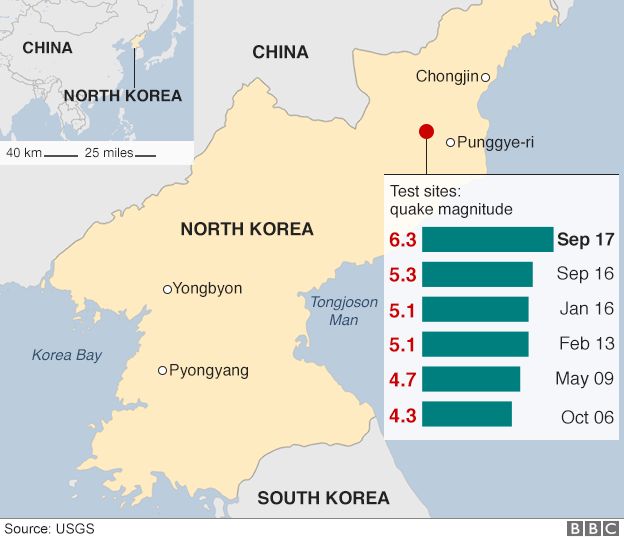
The US Geological Survey put the tremor at 6.3 magnitude.
- Latest updates on the nuclear test
- N Korea: China’s ‘nightmare neighbour’?
- The most powerful nuclear blasts ever
Japanese Foreign Minister Taro Kono said there was no doubt this was North Korea’s sixth nuclear test, calling it “unforgivable”.
Then North Korean state media confirmed this was no earthquake.
It claimed the country had conducted its sixth and most powerful nuclear test, detonating a hydrogen bomb that could be loaded onto a long-range missile.
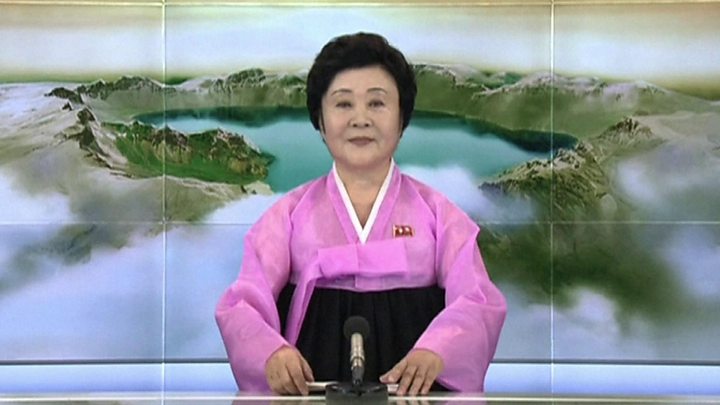
Media captionNorth Korean state media announces “hydrogen bomb” test
North Korean leader Kim Jong-un was pictured with what state media said was a new type of hydrogen bomb.
Analysts say the North’s claims should be treated with caution, but that its nuclear capability is clearly advancing.
Officials in China, where the blast was felt as a tremor, said they were carrying out emergency radiation testing along the border with North Korea.
What has the reaction been?
Denouncing the test as “hostile” and “dangerous”, President Trump described the North as a “rogue nation” which had become a “great threat and embarrassment” to China – Pyongyang’s main ally.
He also said South Korea’s “talk of appeasement” was not working and that the secretive communist state “only understands one thing”.
“The United States is considering, in addition to other options, stopping all trade with any country doing business with North Korea,” Mr Trump later said in a tweet. North Korea relies on China for about 90% of its foreign trade.
- Kim inspects ‘nuclear warhead’: A picture decoded
- ‘Tunnel collapse’ at nuclear site may provide clues
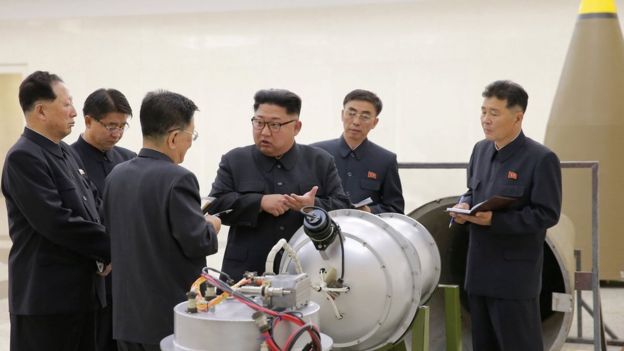 Image copyrightREUTERS/KCNA
South Korean President Moon Jae-in called for the “strongest possible” response, including new UN Security Council sanctions to “completely isolate” the country.
“I can’t help but be disappointed and outraged,” he said, adding that North Korea’s weapons programme was “threatening world peace” and would only “isolate them further”.
China, meanwhile, also expressed “strong condemnation” and said the state “had ignored the international community’s widespread opposition”.
Russia urged all sides involved to hold talks, saying this was the only way to resolve the Korean peninsula’s problems.
UK Prime Minister Theresa May said the “reckless” new test represented an “unacceptable further threat to the international community”. She called on world leaders to come together to stop North Korea’s “destabilising actions”.
What does the test tell us?
South Korean officials said the latest test took place in Kilju County, where the North’s Punggye-ri nuclear test site is situated. The “artificial quake” was 9.8 times more powerful than the tremor from the North’s fifth test in September 2016, the state weather agency said.
Although experts urged caution, this does appear to be the biggest and most successful nuclear test by North Korea to date – and the messaging is clear. North Korea wants to demonstrate it knows what makes a credible nuclear warhead.
Previous nuclear tests
Nuclear weapons expert Catherine Dill told the BBC it was not yet clear exactly what nuclear weapon design was tested.
“But based on the seismic signature, the yield of this test definitely is an order of magnitude higher than the yields of the previous tests.”
Current information did not definitively indicate that a thermonuclear weapon had been tested “but it appears to be a likely possibility at this point”, she said
Hydrogen bombs are many times more powerful than an atomic bomb. They use fusion – the merging of atoms – to unleash huge amounts of energy, whereas atomic bombs use nuclear fission, or the splitting of atoms.
What can be done?
By Jonathan Marcus, BBC defence and diplomatic correspondent
North Korea’s sixth nuclear test – probably its largest so far – sends out one clear political signal.
Despite the bluster and threats from the Trump administration in Washington and near-universal condemnation from around the world, Pyongyang is not going to halt or constrain its nuclear activities.
Worryingly, it also suggests that this is a programme that is progressing on all fronts at a faster rate than many had expected. So far all efforts to pressure North Korea – sanctions, isolation and military threats – have all failed to move Pyongyang.
Could more be done? Certainly, but the harshest economic pressure would potentially cripple the regime and push it towards catastrophe – something China is unwilling to countenance.
Containment and deterrence will now come to the fore as the world adjusts its policy from seeking to roll-back Pyongyang’s weapons programme to living with a nuclear-armed North Korea.
Can the world live with a nuclear North Korea?
Have North Korea’s missile tests paid off?
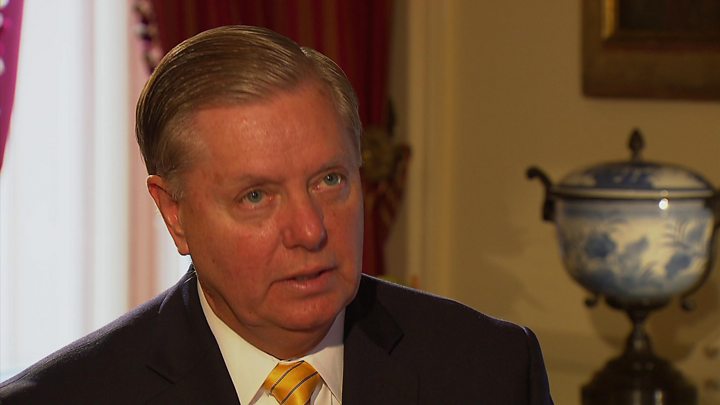 Media captionSpeaking before the new nuclear test, Senator Lindsey Graham told BBC HARDtalk a US attack was inevitable if diplomacy failed
Will China clamp down?
Robin Brant, BBC News, Shanghai
North Korea’s sixth nuclear weapons test is an utter rejection of all that its only ally has called for.
Beijing’s response was predictable – condemnation, urging an end to provocation and dialogue. But it also spoke of urging North Korea to “face up to the firm will” of the international community to see denuclearisation on the Korean peninsula.
There is no sign, though, that China is willing yet to see that “firm will” go beyond UN sanctions, which recently clamped down on seafood and iron ore exports, in addition to the coal and minerals that are already banned from crossing the border.
It is noteworthy also that this test took place just as the Chinese president was about to welcome a handful of world leaders to the two-day showpiece Brics summit on China’s east coast.
Even the state-controlled media will find it hard to ignore the fact that their man has been upstaged – embarrassed too – by its almost universally ostracised ally and neighbour.
Quelle/BBC/USUN/

 NZ
NZ 
09/03/2017 at 22:27
Lies from massive USA pseudo-newa…
LikeLiked by 1 person
09/03/2017 at 22:37
I hope it can not happen,,,,,,Espero que no pueda pasar
LikeLiked by 1 person
09/04/2017 at 18:18
This is all such worrying news, two big superpowers with too much power and too little thought.
LikeLike
09/04/2017 at 18:29
frieden weg ist immer frei und breit genung platz hat und kostet nicht ,, aber krieg bedaurlich weise ein menschliches disaster & disaster die wir alle spüren mussen, was wegen ich wunsche echt frieden in den nahosten und und und und und die südamreka uzw.
LikeLike